Glass industry
The flat glass production process begins with batch preparation, where silica sand, soda ash, sodium sulfate, limestone, dolomite and cullet (recycled glass) are mixed and preheated, prior melting at 1400–1600°C. The molten glass undergoes refining at 1300–1400°C, followed by sheet formation in a tin float bath and gradual cooling in an annealing lehr.
Our superstructure model explores various energy sources, melting technologies, carbon capture methods, and waste heat recovery options to help decarbonize flat glass production.
- Energy Commodities: natural gas (NG), hydrogen (H2), electricity, and waste heat integration.
- Melting Options: conventional NG-fired, oxy-combustion, hybrid (50% electric boosting) and all-electric furnace systems.
- Carbon Capture (CC) Strategies: MEA-based absorption and cryogenic CO₂ compression and purification.
- Waste Heat Utilization: Power generation via supercritical CO₂ rankine cycle and energy recovery for CC.
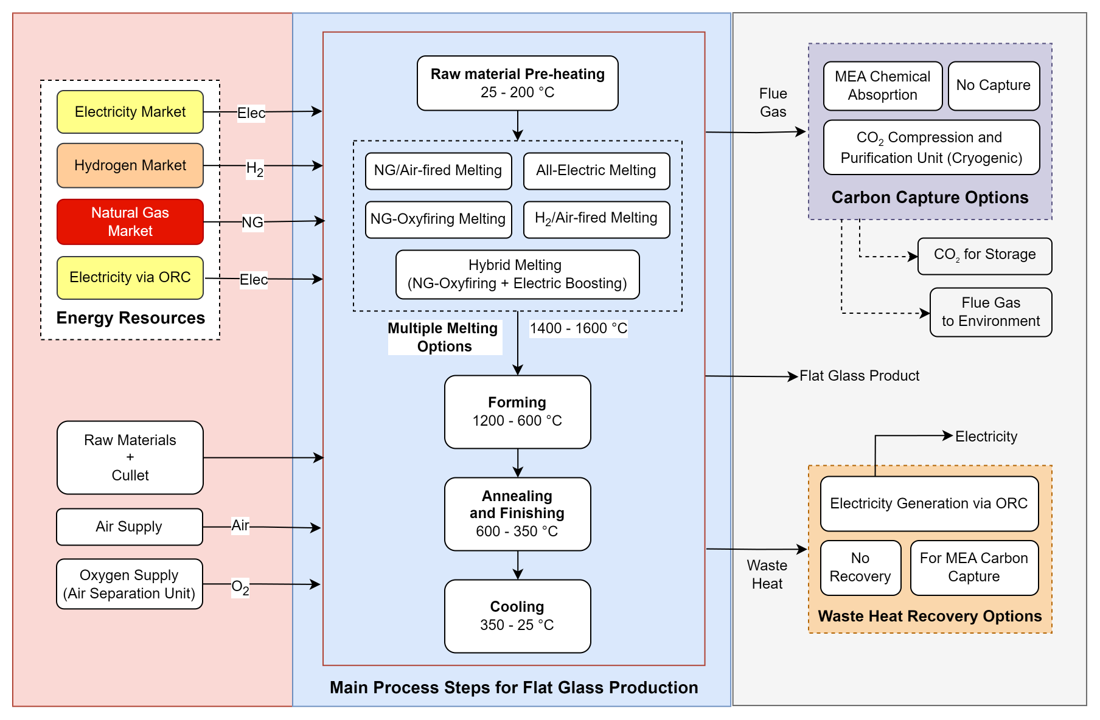
Superstructure of glass production
The following abbreviations are used in the decarbonization analysis:
- NGfur (base case) : NG air-blown furnace without CC
- NGfur-CC: NG air-blown furnace with CC
- NGOxyfur: NG oxy-fuel furnace without CC
- NGOxyfur-CC: NG oxy-fuel furnace with CC
- Hybfur: Hybrid furnace (NG-oxy + 50% Electric boosting) without CC
- Hybfur-CC: Hybrid furnace (NG-oxy + 50% Electric boosting) with CC
- ELfur: All-electric furnace without CC
- ELfur-CC: All-electric furnace with CC
- H2fur: H2-air-blown furnace without CC
- H2fur-CC: H2-air-blown furnace with CC
Select the type of analysis
Check out the full description below for a deep dive into the process!
Energy demand
Emissions outlook
Economic analysis