Sugar industry
Sugar is extracted from sliced beets using hot water, and the resulting juice is purified with lime before being concentrated through multi-effect evaporation. The concentrated juice is then crystallized under vacuum, with centrifugation used to separate sugar crystals from the remaining syrup.
Our superstructure model explores alternative energy sources for heat supply, integration of heat pumps, and implementation of carbon capture to help decarbonize sugar production.
- Energy Commodities: natural gas, biomethane (produced by biodigestion of beet and pulp waste), hydrogen, and electricity.
- Heat recovery: implementation of heat pumps recovering heat from evaporation and drying steps.
- Carbon Capture: chemical absorption (MEA).
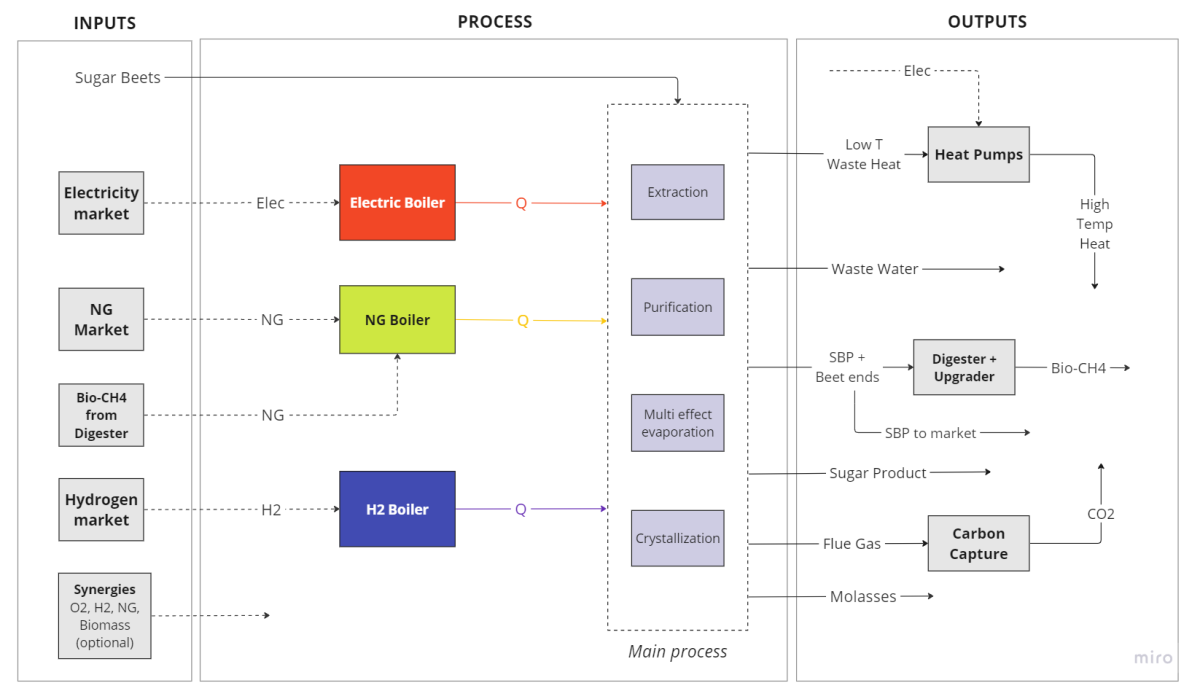
Superstructure of sugar production
The following abbreviations are used for the decarbonization analysis:
- NG (base case): Natural gas-fired boiler
- NG+CC: Natural gas-fired boiler with carbon capture
- NG+HP: Natural gas-fired boiler with heat pump integration
- NG+HP+CC: Natural gas-fired boiler with heat pump integration and carbon capture
- BioCH4: Biomethane-fired boiler
- BioCH4+CC: Biomethane-fired boiler with carbon capture
- BioCH4+HP: Biomethane-fired boiler with heat pump integration
- BioCH4+HP+CC: Biomethane-fired boiler with heat pump integration and carbon capture
- H2: Hydrogen-fired boiler
- H2+HP: Hydrogen-fired boiler with heat pump integration
- EL: Electric boiler
- EL+HP: Electric boiler with heat pump integration
Select the type of analysis
Check out the full description below for a deep dive into the process!
Energy demand
Emissions outlook
Economic analysis