Instant coffee industry
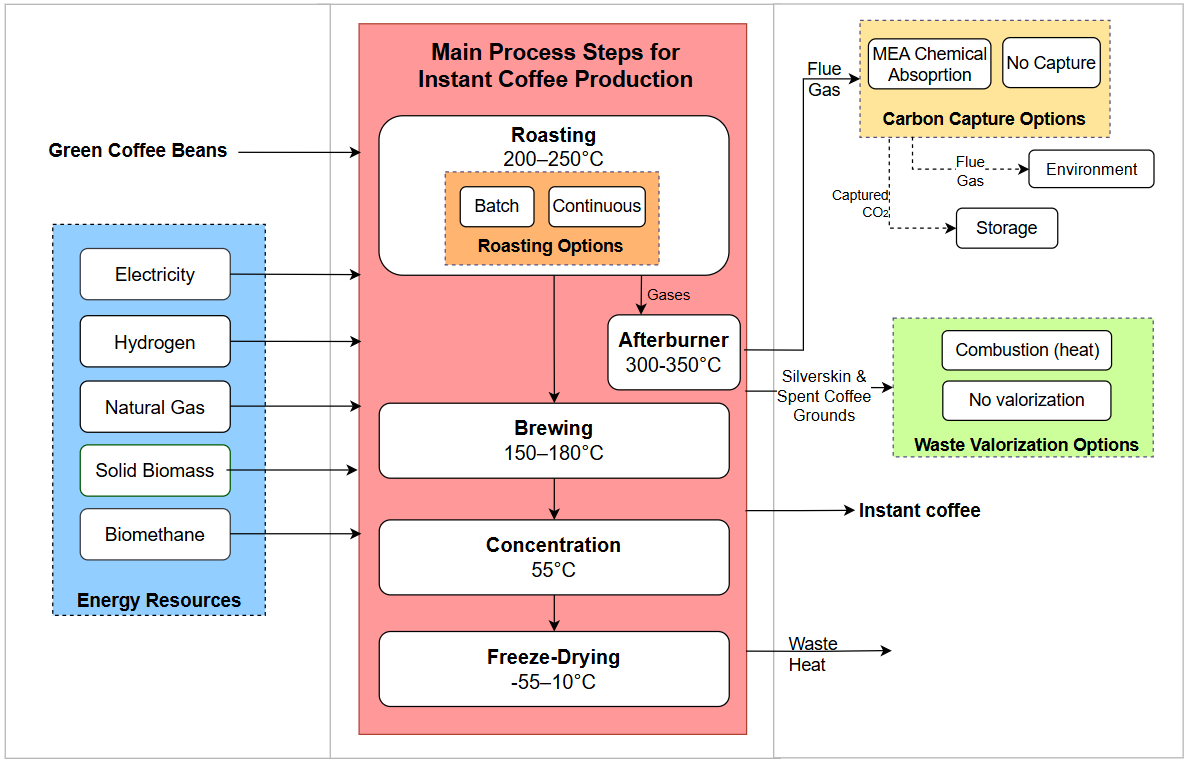
Instant coffee production involves roasting, brewing, concentration, and drying steps. Green coffee beans are first roasted and ground before undergoing hot-water-based extraction (i.e., brewing) to produce a coffee extract, with spent coffee grounds generated as the main by-product. The extract is subsequently concentrated by evaporation and dried by freeze-drying to obtain the final instant coffee product.
Our superstructure model explores alternative energy sources for heat supply, roasting technologies, waste valorization, and implementation of carbon capture to help decarbonize instant coffee production.
- Energy Commodities: natural gas, biomethane, biomass (wood), hydrogen, and electricity.
- Roasting Technologies: batch or continuous roasting.
- Waste Valorization: spent coffee grounds and coffee silverskin combustion for heat supply.
- Carbon Capture: implementation of chemical absorption (MEA).
Superstructure of instant coffee production
The following abbreviations are used for the decarbonization analysis:
- NG (base case): Natural gas combustion for heat supply
- NG-CC: Natural gas combustion for heat supply with carbon capture
- BioCH4: Biomethane combustion for heat supply
- BioCH4-CC: Biomethane combustion for heat supply with carbon capture
- BM: Biomass (wood + process waste) combustion for heat supply
- BM-CC: Biomass combustion for heat supply with carbon capture
- BM/NG: Natural gas and biomass (wood + process waste) combustion for heat supply
- BM/NG-CC: Natural gas and biomass combustion for heat supply with carbon capture
- H2: Hydrogen combustion for heat supply
- EL: Electrically-powered heat supply
- Eff: Energy demand reduction through continuous roasting (natural gas combustion)
Select the type of analysis
Check out the full description below for a deep dive into the process!
Energy demand
Emissions outlook
Economic analysis