Lime industry
Quicklime (or lime) is produced by thermal decomposition of limestone, implemented at high temperatures (900-1100°C). Our superstructure model explores various energy sources, kiln technologies, carbon capture methods, and CO₂ storage and utilization options to help decarbonize quicklime production.
- Energy Commodities: natural gas, hydrogen, solid biomass, biomethane, and electricity.
- Kiln Technologies Options: conventional air-fired Parallel Flow Regenerative Kiln (PFRK), oxy-combustion, and electric kiln.
- Carbon Capture Strategies: chemical absorption (MEA) and cryogenic CO₂ compression and purification (CPU).
- Post-Capture CO₂ Trajectories: geological storage and utilisation for e-methane production.
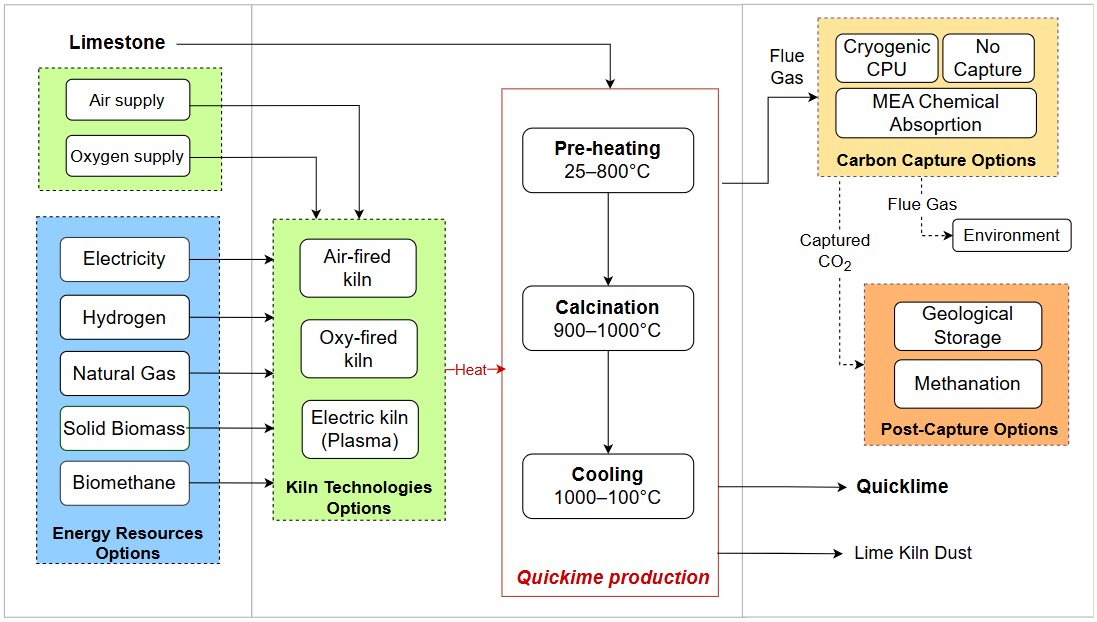
Superstructure of lime production
The following abbreviations are used for the decarbonization analysis:
- NG (base case): Natural gas air-fired kiln without CO₂ capture
- NG-CC: Natural gas air-fired kiln with CO₂ capture (MEA)
- NGOxy-CC: Natural gas oxy-fired kiln with CO₂ capture (CPU)
- Plasma-CC: Electric kiln with CO₂ capture (CPU)
- BioCH4: Biomethane air-fired kiln without CO₂ capture
- BioCH4-CC: Biomethane air-fired kiln with CO₂ capture (MEA)
- BioCH4Oxy-CC: Biomethane oxy-fired kiln with CO₂ capture (CPU)
- H2Oxy-CC: Hydrogen oxy-fired kiln with CO₂ capture (CPU)
- Biomass: Solid biomass air-fired kiln without CO₂ capture
- Biomass-CC: Solid biomass air-fired kiln with CO₂ capture (MEA)
- BiomassOxy- CC: Solid biomass oxy-fired kiln with CO₂ capture (CPU)
- CCU: E-methane (from captured CO₂ in CPU and electrolytic hydrogen) oxy- fired kiln
Select the type of analysis
Check out the full description below for a deep dive into the process!
Energy demand
Emissions outlook
Economic analysis